

SDA Assessment
Melbourne
Mobile OT housing evidence for a Specialist Disability Accommodation request, with referrals accepted from anywhere in Melbourne.
What is an SDA Assessment?
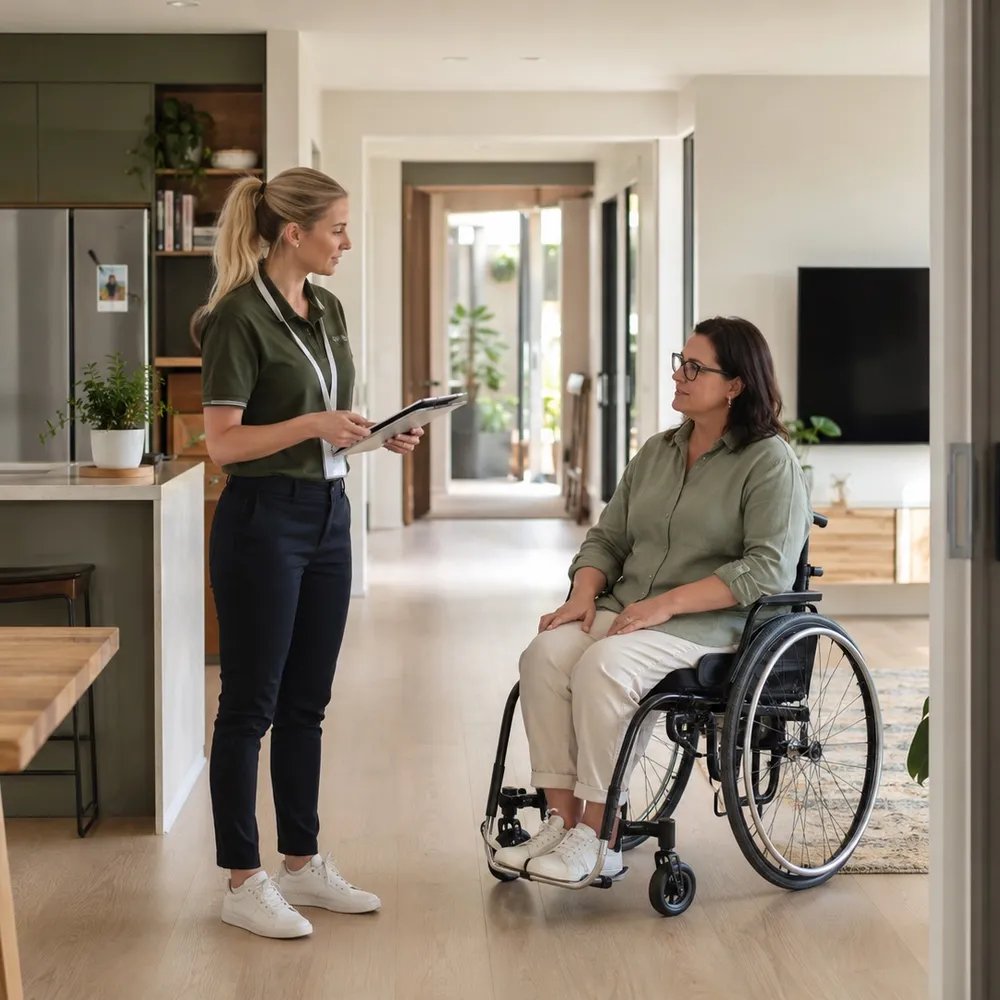
A Specialist Disability Accommodation (SDA) assessment is a detailed occupational therapy evaluation that connects your functional capacity to your housing needs. Conducted in your home by an AHPRA-registered OT, it documents why your current home is unsuitable and which specialist housing design features you require to live safely.
An SDA assessment documents clinical evidence relevant to SDA eligibility and design category. The NDIA considers this with other information and decides whether SDA meets the NDIS funding criteria. This is not SDA dwelling design certification, which the NDIS explains is completed by an accredited third-party SDA assessor.
Compare this housing-focused service with a general functional capacity assessment, a SIL support-needs assessment, or our assistive technology assessment service.
- Documents evidence relevant to housing features and design category
- Functional capacity and home environment evidence
- AHPRA-registered occupational therapists
- NDIS plan-managed and self-managed participants
- Mobile assessments, with referrals accepted from anywhere in Melbourne
What We Assess
Functional Capacity
Your abilities and limitations across daily living tasks, mobility, transfers, and self-care, assessed in your actual home environment for accuracy.
Home Environment Barriers
How your current home limits your independence and safety, including access, bathroom, kitchen, doorways, circulation space, and fixtures.
Support Needs
The type and amount of person-to-person support you require, and how the built environment helps or hinders that support being delivered.
Housing-Related Risks
Falls, manual handling and transfer hazards, pressure injury risk, and behaviours of concern that arise from the current housing layout.
SDA Design Category
A recommended design category, from Improved Liveability through to High Physical Support, matched to your assessed functional needs.
Why Specialist Housing
A clear clinical justification for why specialist accommodation is required rather than mainstream housing with home modifications.
Understanding SDA Assessments
Who needs an SDA assessment?
An SDA assessment may be requested or useful when a participant needs functional evidence for a Specialist Disability Accommodation request. Common situations include:
- Applying for SDA funding for the first time as part of a Home and Living request
- A current home that is unsafe or unsuitable for your disability-related needs
- Transitioning from hospital, residential aged care, or the family home into specialist accommodation
- Moving from one SDA dwelling to another with different design requirements
- An NDIS plan review where your housing needs have changed
- A younger person seeking to move out of residential aged care (YPIRAC pathway)
The SDA assessment process
Our SDA assessment follows a structured process designed to produce evidence that meets the NDIA's reasonable and necessary criteria:
Pre-Assessment Review
We gather existing reports, current housing details, NDIS plan information, and the Behaviour Support Plan if applicable. We consult with your support coordinator to understand the housing outcome being sought.
In-Home Assessment
Your OT visits your home to assess how you manage daily tasks and how the built environment affects your independence and safety. This includes standardised assessment tools.
Standardised Scoring
We use validated clinical assessment tools to provide objective, measurable evidence of your functional capacity and support needs.
Report and Delivery
A comprehensive report is prepared covering functional findings, environmental barriers, a recommended SDA design category, and numbered recommendations with clinical justification.
What is included in the SDA report
Your SDA assessment report is a detailed clinical document designed for the NDIA's Home and Living decision process. It includes:
- Functional assessment findings across daily living domains
- Standardised tool results providing objective, measurable evidence
- A detailed analysis of the barriers in your current home environment
- Quantified person-to-person support needs
- A housing-related risk assessment (falls, transfers, pressure injuries, behaviour)
- A recommended SDA design category with supporting rationale
- Specific design feature and building type recommendations
- A clear justification for specialist housing versus mainstream housing with modifications
- Consideration of assistive technology and home modification alternatives
- Numbered recommendations linked to observed functional needs
Why choose Flourish Health for your SDA assessment
We are an occupational therapy practice focused on getting your housing evidence right, so your Home and Living request rests on a clear, well-structured report:
- AHPRA-registered occupational therapists
- Assessed in your own home, where we can see how the environment affects you day to day
- Reports organise functional and housing evidence relevant to the NDIA’s SDA decision
- We work directly with you and your support coordinator
- Plan-managed and self-managed participants welcome from anywhere in Melbourne
SDA design categories
SDA dwellings are built to one of four design categories, each with specific features for different levels of need. The categories are an NDIS framework, not a claim that every Flourish clinician covers every category. We confirm scope and clinician suitability before booking; where appropriate, the OT report explains which category and features appear relevant to the assessed functional needs:
- Improved Liveability: housing with a better level of physical access and enhanced provision for people with sensory, intellectual, or cognitive impairment
- Fully Accessible: housing with a high level of physical access provision for people with significant physical impairment
- Robust: housing that is resilient and reduces risk to the participant and the community, for people who may need a safer, more durable environment
- High Physical Support: housing with a very high level of physical access provision for people who need very high levels of support, including features such as structural provision for ceiling hoists and assistive technology
Our assessment documents relevant clinical evidence and reasoning. The NDIA considers the report with other information and makes the funding decision. For local mobile coverage, see our occupational therapy service in Melbourne’s eastern suburbs.
Funding options for SDA assessments
Funding suitability and the expected assessment scope are confirmed before booking.
Self-Managed NDIS
You manage your own NDIS funds and choose your providers directly.
- Pay Flourish Health directly from your plan
- Claim from the NDIS portal after each session
- Can generally choose registered or unregistered providers
Plan-Managed NDIS
A plan manager handles your invoicing and claims on your behalf.
- Your plan manager handles invoices and claims
- We work directly with plan managers
- Can generally access registered and unregistered providers
Private Pay
An SDA-focused OT assessment may also be arranged privately after we confirm clinical suitability and scope.
Your SDA assessment journey
From your first contact to receiving your report, here is how the process works.
Step 1
Get in Touch
Call us, submit a referral, or have your support coordinator reach out.
Step 2
Pre-Assessment
We review existing reports, current housing, and consult with your SC on the request.
Step 3
In-Home Assessment
Your OT assesses daily tasks, the home environment, and safety in your home.
Step 4
Report Writing
Functional findings, environmental barriers, design category, and recommendations prepared.
Step 5
Delivery & Follow-Up
Report delivered to you and your support team. Available for NDIA follow-up questions.
Frequently Asked Questions
What is an SDA assessment?
How is an SDA assessment different from an FCA or SIL assessment?
How is an SDA assessment funded?
What happens after the assessment?
What does the NDIA look for in an SDA report?
Is an OT SDA assessment the same as SDA dwelling certification?
What is the turnaround time for an SDA assessment?
Can't find what you're looking for? We're happy to help.